

Blog
Wastewater Treatment Plant Manufacturers in Bikaner

 95215 44147

 Enquire Now
Wastewater Treatment Plant Manufacturers in Bikaner | Aquacaresee Pvt. Ltd.
Finding dependable Wastewater Treatment Plant Manufacturers in Bikaner has become a priority for factories, dairies, food units and commercial campuses across this arid part of Rajasthan. Water is scarce and discharge expectations keep tightening, so a poorly matched plant quickly turns into a costly burden. The right manufacturer builds a system around the real wastewater treatment challenge your site faces.
Aquacaresee Pvt. Ltd. has fabricated and commissioned treatment plants since 2006, covering effluent, sewage and process water. Each unit is sized to the flow, pollutant load and reuse goal of the client instead of being lifted from a catalogue. Transparent drawings, tested equipment and honest timelines keep every project steady from first enquiry to final start-up.
Before shortlisting manufacturers, share your effluent details so our engineers can propose a fitting plant. You can also read our company profile and recent installations, or follow project updates on our Facebook page. A little homework now prevents expensive corrections later.
Call Now: 95215 44147
Website: https://aquacaresee.com
About Us
Aquacaresee Pvt. Ltd. is an engineering firm focused on water and wastewater treatment, working in the field since 2006. In two decades we have delivered plants to a wide spread of industrial and commercial clients, and our Jaipur office now serves Rajasthan, including Bikaner.
Among reliable wastewater treatment plant manufacturers in Bikaner, our scope includes:
- Designing, fabricating and installing ETP, STP, WTP, RO and ZLD plants
- Start-up supervision with hands-on operator training
- AMC and O&M programmes for long-term reliability
- Technical consultancy and complete turnkey delivery
Our approach is straightforward: study the effluent first, choose technology second, and stay involved after handover. Browse our video channel for project glimpses, or read up on water treatment basics at Wikipedia before you speak with us.
What Goes Into a Manufactured Wastewater Treatment Plant
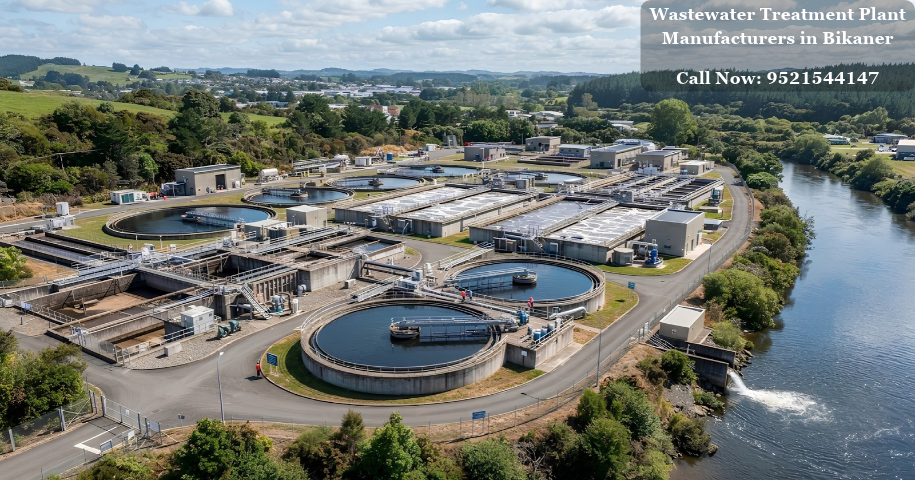
A wastewater treatment plant takes used water from production, washing and sanitation and cleans it until it can be reused or discharged safely. The manufacturer turns that idea into physical equipment such as tanks, pumps, blowers, filters, membranes and control panels, all matched to the effluent your site generates. Choosing among wastewater treatment plant manufacturers in Bikaner therefore means choosing who will engineer that match.
Typical components fabricated and supplied in a plant package:
- Bar screens and grease traps
- Collection and equalisation tanks
- pH correction and coagulant dosing systems
- Clarifiers paired with sand and carbon filters
- Aeration or MBBR biological reactors
- Ultrafiltration and reverse osmosis skids
- Evaporators and dryers for high-TDS streams, where required
- Sludge handling units with automation panels
No two sites need an identical lineup. The final configuration depends on where the effluent comes from, how strong it is, how much flows each day and what quality you expect from the treated water.
That is why manufacturing should begin with sampling and process study rather than a price list. A correctly specified plant avoids oversizing, trims power use and keeps chemical consumption under control.
Why Bikaner Industries Are Investing in Effluent Treatment
Bikaner has a dry climate where every litre of groundwater counts. Food, dairy, textile and stone-processing units all draw water and release effluent that needs careful handling before it leaves the premises.
1. Making Limited Water Go Further
Recycling treated effluent reduces the fresh water a unit must source, which matters most where supply is unreliable.
2. Protecting Soil and Drains from Industrial Discharge
Untreated effluent can carry oils, salts, organic load, dyes and suspended solids. Treating it at the source safeguards land, drains and the communities around your site.
3. Staying Aligned with Pollution Control Norms
Every industry must follow the consent conditions that apply to it. A properly built plant makes discharge quality easier to monitor and records easier to produce during inspections.
4. Putting Reclaimed Water to Work
Reclaimed water can often serve in:
- Cooling tower make-up.
- Floor and yard washing.
- Gardens and green belts.
- Flushing and other non-drinking uses.
- Selected process steps, depending on water quality.
5. Forecasting Water Needs with Confidence
Once a recovery loop is running, managers can predict demand more accurately and depend less on tankers or borewells. Over time this steadies operating costs and makes expansion easier to plan.
How Contaminated Water Becomes Reusable: Stage by Stage
A complete plant guides water through linked stages, and each one removes a different group of pollutants before the next begins.
1. Stage One: Collection and Flow Balancing
An equalisation tank absorbs sudden surges so that every later unit receives a consistent volume and strength of effluent.
2. Stage Two: Screening, Dosing and Settling
Screens, oil traps, chemical dosing and clarifiers remove coarse solids, grease and settleable matter.
3. Stage Three: Biological and Chemical Treatment
Microbial or chemical processes break down dissolved organics and lower the COD and BOD of the wastewater.
4. Stage Four: Fine Filtration Before the Membranes
Sand, carbon and cartridge filters, along with ultrafiltration where needed, clear away fine particles to protect the membranes that follow.
5. Stage Five: Salt Removal Through RO
Reverse osmosis forces water through very tight membranes, holding back dissolved salts as reject and delivering reusable permeate.
Treatment Modules We Build and Integrate
Technology selection should follow your effluent profile and your reuse target. These are the modules we most often combine when engineering a plant for a client.
1. Reverse Osmosis Units
RO uses pressure and semi-permeable membranes to separate dissolved salts from water, making recycling a realistic goal for many industries.
Key advantages:
- Delivers water fit for reuse.
- Cuts the dissolved salt content of the treated stream.
- Backs in-house recycling programmes.
- Reduces the volume passed on to thermal treatment.
2. Ultrafiltration Skids
UF skids serve as a fine barrier that retains suspended particles, colloids and some microorganisms, and they are usually installed ahead of RO to safeguard its membranes.
Key advantages:
- Removes fine suspended impurities.
- Provides dependable pretreatment for RO.
- Keeps later stages running steadily.
- Helps limit membrane fouling when well operated.
3. Multiple-Effect Evaporation Systems
When effluent carries a heavy salt load, evaporators heat it across several linked stages, recovering water as condensate while reducing the volume of concentrated liquid.
Key advantages:
- Manages highly concentrated streams.
- Returns condensate for further treatment and reuse.
- Reduces the liquid residue left behind.
- Works well alongside crystallisation and drying units.
4. Mechanical Vapour Recompression Systems
An MVR system compresses the vapour it generates and returns that heat to the evaporation step. In suitable duties this can consume less energy than a conventional steam-driven evaporator.
Key advantages:
- Reuses latent heat within the process.
- May lessen the need for external steam.
- Provides efficient evaporation.
- Suits continuous industrial operation.
5. Agitated Thin Film Drying Systems
An ATFD spreads concentrated liquid into a thin film over a heated wall, while rotating blades keep the material moving so the last traces of moisture leave the solids.
Key advantages:
- Copes with thick concentrated residues.
- Lowers moisture in suitable waste streams.
- Helps recover the solid fraction.
- Slots neatly into a larger treatment train.
Reasons Industries Prefer Aquacaresee
Working with a specialist manufacturer brings benefits that go well beyond the equipment itself.
1. A Plant Engineered Around Your Own Effluent
Our engineers study your flow and water-quality data first, so capacity and technology are chosen to suit the job rather than guessed. This protects both your budget and your treatment results.
2. One Team Accountable from Design to Start-up
Design, fabrication, installation and commissioning stay under one roof, which removes the blame-shifting that can arise when several vendors share a single project.
3. Lower Operating Bills Year After Year
Properly sized equipment, efficient aeration and sensible chemical dosing keep electricity and consumable costs in check across the years.
4. Dependable Service Once the Plant Is Running
AMC and O&M services keep performance consistent and help catch small faults before they grow into costly shutdowns.
5. Simpler Records for Audits and Inspections
A well-instrumented plant makes sampling, logging and reporting easier, so your team spends less time hunting for figures during audits.
Points to Confirm Before Placing a Plant Order
A little groundwork at the start can save months of rework once construction begins.
Before settling on a manufacturer, businesses should:
- Check the consent conditions and norms that apply to the unit.
- Send representative effluent samples to a laboratory for testing.
- Decide what the treated water will be reused for.
- Estimate both current and future daily flow.
- Plan how sludge and solid residue will be handled.
- Request a clear service and spare-parts plan.
A manufacturer can guide each of these steps, but approvals and compliance ultimately depend on how the installed plant performs under real operating conditions.
E-E-A-T (Experience, Expertise, Authoritativeness, Trustworthiness)
Experience
Since 2006, Aquacaresee has planned, built and serviced treatment plants for a diverse client base. More than twenty years of field history shows in practical details such as plant layout, maintenance access and sensible equipment choice. That is why our track record counts for more than any brochure.
Expertise
Our engineers work across ETP, STP, WTP, RO and ZLD technologies, so processes are selected on merit instead of pushing a single product. As wastewater treatment plant manufacturers in Bikaner, we cross-check every design against the effluent data the client provides before fabrication begins.
Authoritativeness
Aquacaresee is recognised in the water treatment field for turnkey delivery and technical consultancy, with offices in Navi Mumbai, Pune and Jaipur. The staged approach we follow is consistent with the principles described in general references on wastewater treatment fundamentals.
Trustworthiness
We offer a defined scope, written proposals and realistic performance expectations. After handover, AMC and O&M services keep the plant dependable, and our team stays reachable through the contact page whenever questions come up.
Frequently Asked Questions (FAQs)
Q1. What do wastewater treatment plant manufacturers in Bikaner typically deliver?
Ans: A manufacturer engineers the treatment process, fabricates or sources the equipment, brings it to site, installs and commissions it, and usually supports it afterwards. The goal is a working plant matched to your effluent, not simply a collection of tanks and pumps.
Q2. What determines the capacity of the plant I need?
Ans: Capacity follows from daily effluent volume, peak flow, pollutant concentration and your expansion plans. Laboratory results from a representative sample let engineers decide both the size and the treatment stages.
Q3. Which kinds of businesses near Bikaner usually need an effluent or sewage plant?
Ans: Namkeen and food units, dairies, wool and textile processors, stone and mineral works, hotels, hospitals and residential or commercial complexes commonly need some form of wastewater treatment, depending on what they discharge.
Q4. Is it possible to reuse the treated water, and where?
Ans: In many cases, yes. Depending on the quality achieved, treated water can serve for cooling make-up, washing, gardening, flushing and selected process uses. Drinking water is not part of this reuse.
Q5. Will someone look after the plant once it is installed?
Ans: Yes. Aquacaresee offers Annual Maintenance Contracts and Operation & Maintenance services so that equipment is inspected, serviced and fine-tuned regularly, helping the plant deliver consistent results.
Contact Us
- Phone:+ 91 – 95215 44147
- Email: marketing@aquacaresee.com
- Website: www.aquacaresee.com
- Add: 8th floor office No.810, KAMDHENU 23 WEST, TTC Industrial Area, MIDC Industrial Area, Pawne, Navi Mumbai, Maharashtra 400705, Navi Mumbai, Maharashtra 400705.
- Add: Office No. 204, Aquacaresee Pvt. Ltd.; 205; and 206, Old Mumbai-Pune Hwy, opp. Hotel Silver Seven, Akurdi Gaothan, Vivek Nagar, Akurdi, Pimpri-Chinchwad, Pune, Maharashtra 411035.
- Add: Hanuman Vatika, F/1 – 56-A/3, I, opposite Golden Dags Resorts, near 200 Feet Bypass Road, Hanuman Vatika-1, Heerapura, Heerawala, Jaipur, Rajasthan 302024.
Conclusion
Choosing among trusted Wastewater Treatment Plant Manufacturers in Bikaner shapes how smoothly your site manages effluent for years to come. Look for a partner who studies your water first, designs around real data and stays available after commissioning. That combination protects budgets, water resources and compliance records alike.
Aquacaresee Pvt. Ltd. offers design, fabrication, installation, commissioning and upkeep of effluent, sewage, water treatment, RO and ZLD systems. Share your requirements on our enquiry page, and our team will recommend a practical plant for your site.
Call Now: 9521544147
“Please share this post with your network!”