
Blog
Wastewater Recycling Plant Manufacturer in Jaipur



 Enquire Now
Wastewater Recycling Plant Manufacturer in Jaipur | Aquacaresee
A Water Treatment Plant Manufacturer in Jaipur helps industries recover usable water from process effluent and reduce dependence on fresh water sources. As a trusted water treatment company, Aquacaresee designs systems that treat, polish, and recycle wastewater for non-potable and process applications. Every wastewater recycling system is engineered around the actual effluent profile, flow rate, and reuse goal of the facility.
Industrial facilities in Jaipur and across Rajasthan generate wastewater from manufacturing, processing, cooling, washing, and utility operations. Instead of discharging this water after basic treatment, a properly designed recycling plant allows it to be reused within the same facility. This approach supports water conservation while lowering operating costs linked to fresh water purchase and discharge compliance.
Call Now: 9653247121
Website: https://aquacaresee.com
Understanding Wastewater Recycling Technology
A wastewater recycling plant combines physical, chemical, and biological processes to clean effluent to a quality suitable for reuse. Depending on the source and intended application, the system may include screening, equalization, biological treatment, clarification, filtration, disinfection, and membrane-based polishing. The output water can be directed to cooling towers, flushing systems, gardening, or selected process steps.
The exact treatment train is decided after studying parameters such as pH, TSS, BOD, COD, TDS, oil and grease, and heavy metals. This is why a Wastewater Recycling Plant Manufacturer in Jaipur must evaluate each project individually rather than offering a single standard design for every site.
Aquacaresee engineers and manufactures complete recycling plants that can be integrated with existing treatment infrastructure or installed as standalone systems.
Typical recycling flow:
Raw effluent → Primary treatment → Biological treatment → Filtration → Disinfection → Treated water for reuse
This kind of system is especially useful where water availability is limited, discharge norms are strict, or the facility wants to reduce its environmental footprint. Aquacaresee provides end-to-end support from design to long-term maintenance.
Industries That Benefit from Wastewater Recycling in Jaipur
Jaipur is home to a diverse industrial base, including textile processing, dyeing, food processing, pharmaceuticals, hospitality, and light engineering units. Many of these sectors produce wastewater with characteristics that make direct discharge difficult and expensive. A recycling plant allows them to treat and reuse water internally.
Key advantages of a well-designed recycling system include:
Reduced Freshwater Intake
Recycled water can replace a portion of the freshwater used for cooling, washing, or utilities, which reduces overall water procurement.
Lower Discharge Load
When more water is reused internally, the volume sent to drains or common effluent treatment facilities drops, easing compliance pressure.
Better Sustainability Scores
Recycling supports environmental targets and can strengthen the plant’s position in audits, certifications, and customer evaluations.
Stable Production Planning
With recycled water available on site, production is less vulnerable to water supply fluctuations or restrictions during dry periods.
Recovery of Valuable Resources
In some streams, by-products or salts can be recovered and reused, turning a waste stream into a partial resource.
Recycling Solutions Tailored to Different Sectors
No two industries produce identical effluent. Aquacaresee designs each recycling plant around the specific flow, contaminant profile, and reuse target of the client. This ensures the system performs reliably under real operating conditions, not just on paper.
Textile and Dyeing Units
Textile processing generates wastewater with high colour, salts, and COD. A Wastewater Recycling Plant Manufacturer in Jaipur like Aquacaresee can provide treatment trains that decolourise, reduce organic load, and recover water suitable for rinsing or utility use.
Pharmaceutical and Chemical Plants
These facilities need careful handling of effluent containing organic residues, solvents, and variable pH. Recycling systems can be designed to segregate streams and treat them to a quality suitable for cooling or utilities.
Hotels and Hospitality
Hotels generate greywater from kitchens, laundry, and rooms. A recycling plant can treat this water for gardening, flushing, and cooling tower make-up, significantly reducing freshwater bills.
Food and Agro-Processing
Effluent with high organic load and suspended solids can be treated biologically and polished for reuse in washing, cleaning, or landscape irrigation.
Municipal and Community Projects
For municipal bodies and large campuses, recycling plants can reduce load on public treatment infrastructure and provide recycled water for parks, construction, or non-potable uses.
Why Work with Aquacaresee for Your Recycling Plant
Choosing the right partner for a recycling plant matters because the long-term performance of the system depends on proper design, equipment quality, installation, and maintenance support.
Aquacaresee has been active since 2006 and has over two decades of experience in water and wastewater treatment.
Our capabilities include:
- Process design and engineering
- In-house manufacturing
- Supply of equipment
- Installation and commissioning
- Consultancy services
- Turnkey project execution
- Annual maintenance contracts
- Operation and maintenance support
This means clients can work with one experienced team from concept to operation, without coordinating multiple vendors.
How a Wastewater Recycling Plant Works
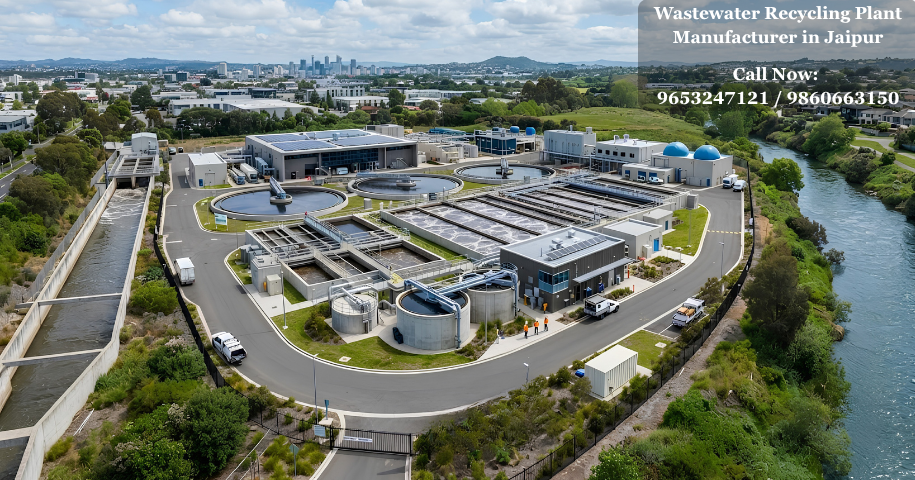
A Wastewater Recycling Plant treats effluent through a series of stages, each removing specific types of contaminants and preparing the water for the next step.
Collection and Equalization
Effluent is collected and stored in equalization tanks to balance flow and concentration variations.
Primary Treatment
Physical processes remove suspended solids, oil, grease, and settleable material.
Biological Treatment
Aerobic or anaerobic processes reduce organic pollutants measured as BOD and COD.
Filtration and Polishing
Sand filters, activated carbon, or membrane systems remove fine particles, colour, and residual organics.
Disinfection
Chlorination, UV, or ozonation eliminates pathogens before reuse.
Storage and Reuse
Treated water is stored and then pumped to the points of reuse, with quality monitoring as required.
Sludge Handling
Sludge generated during treatment is thickened, dewatered, and disposed of or reused according to applicable norms.
Optional Advanced Treatment
For higher reuse quality, RO, UF, or advanced oxidation can be added to the treatment train.
Custom Engineering vs. Standard Recycling Packages
Industrial effluent is rarely uniform across facilities.
Two plants may produce the same volume of wastewater but with entirely different TDS, COD, hardness, and scaling tendencies.
A generic package chosen only on capacity may underperform or require frequent modifications.
A custom-designed system accounts for:
- Actual effluent chemistry
- Process-specific reuse quality
- Target recovery percentage
- Available footprint
- Power and chemical availability
- Operator skill and maintenance capability
- Future expansion plans
This approach results in a recycling plant that is more closely matched to the client’s actual operating conditions and long-term goals.
Recycling and Circular Water Management
Water sustainability is becoming a standard part of industrial planning.
Instead of relying entirely on fresh water, industries can adopt a circular model:
Freshwater → Production → Effluent → Treatment → Recycled Water → Reuse
A Wastewater Recycling Plant Manufacturer in Jaipur can help close this loop, reducing freshwater intake and discharge volume simultaneously.
By recovering water from effluent, industries can lower their freshwater demand, reduce procurement costs, and improve overall resource efficiency.
Future Trends in Industrial Water Recycling
The next generation of recycling systems will focus on higher recovery rates, lower energy consumption, and smarter monitoring.
Emerging trends include:
- Advanced membrane materials
- Energy-efficient aeration and pumping
- IoT-based monitoring and control
- Predictive maintenance
- Automatic chemical dosing
- Better concentrate and brine management
- On-site reuse integration
- Recovery of salts and by-products
Companies investing in a recycling plant should consider not only immediate treatment needs but also long-term water management goals.
E-E-A-T | Why Aquacaresee is a Trusted Industry Partner
Experience
Aquacaresee has been designing, manufacturing, and servicing water and wastewater systems since 2006. Over 20+ years, the company has worked across multiple industries, giving it practical insight into real-world operating conditions.
Expertise
The team covers design, engineering, manufacturing, installation, commissioning, AMC, turnkey execution, and O&M. This breadth allows Aquacaresee to handle complete recycling projects without relying on multiple external vendors.
Authoritativeness
Aquacaresee focuses exclusively on water and wastewater treatment, building deep domain knowledge in recycling, ZLD, WWTP, and industrial water management. This specialization makes it a reliable reference point for complex projects.
Trustworthiness
The company provides clear service information, project-specific recommendations, and transparent commercial terms. Clients receive honest guidance based on their effluent characteristics, capacity, and reuse objectives.
FAQ
Q1. What does a wastewater recycling plant do?
Ans: It treats industrial or municipal effluent and produces water clean enough to be reused in cooling, washing, gardening, flushing, or selected process steps, reducing freshwater intake and discharge volume.
Q2. Which industries in Jaipur can use recycled wastewater?
Ans: Textile processing, dyeing, food processing, pharmaceuticals, hotels, and municipal campuses can all benefit from recycling systems designed for their effluent profile.
Q3. Why choose Aquacaresee as a recycling plant manufacturer?
Ans: Aquacaresee has been operating since 2006 and offers 20+ years of experience in design, manufacturing, installation, commissioning, AMC, and O&M for water and wastewater systems.
Q4. Can the recycling plant be customized for our effluent?
Ans: Yes. Every system is engineered after studying flow rate, pH, TSS, BOD, COD, TDS, and reuse targets. Customization is standard, not optional.
Q5. How do I contact Aquacaresee for a project in Jaipur?
Ans: You can call 9653247121 or email marketing@aquacaresee.com. The team will discuss your requirements and propose a suitable recycling solution.
Contact Us
Looking for a reliable Wastewater Recycling Plant Manufacturer in Jaipur? Contact Aquacaresee for a custom solution designed around your effluent and reuse goals.
Conclusion
A Wastewater Recycling Plant Manufacturer in Jaipur can help industries reduce freshwater consumption, lower discharge volumes, and improve overall water efficiency. But the success of any recycling plant depends on accurate effluent characterization, correct process design, quality equipment, and consistent maintenance.
Aquacaresee, established in 2006, brings 20+ years of experience in water and wastewater treatment. From design and manufacturing to installation, commissioning, AMC, and O&M, the company supports clients through the entire lifecycle of their recycling plant.
For manufacturing, textile, food, pharma, hospitality, and municipal applications, Aquacaresee can evaluate your requirements and propose a practical recycling strategy. Reach out today to discuss your project.
Call Now: 9653247121
“Don’t forget to share this post!”